The Reactive Trap: Why Casework Rewards the Connected
Imagine a first-generation immigrant whose Medicare coverage has been wrongly terminated. He doesn’t know that his congressional representative has a casework office. He doesn’t know which level of government handles health insurance. He’s not sure he’d be taken seriously if he called. So he doesn’t. He navigates the bureaucratic maze alone, or, he gives up entirely.
Now imagine a middle-income retiree whose Medicare claim has been delayed. She’s called her congressman’s office before. She knows the number and is familiar with the staff. She calls again, and the problem gets resolved within days.
Fundamentally, these two constituents are facing the same problem: a government benefit isn’t working as it should. But in reality, only one of them gets help. The difference isn’t the severity of the need, rather, it’s who knows how to ask.
This is the impact of a reactive approach to constituent services—and it is baked into the very structure of how congressional offices currently work.
The Reactive Casework Model: Neutral by Design, Unequal by Outcome
The Reactive Casework Model is the standard operating mode of most modern legislative offices: the office responds when a constituent makes contact, but does not initiate that contact. Coined by political scientist Megan Rickman Blackwood, the term describes a system that is neutral in design but unequal in outcome, because it inherits whatever civic inequality already exists upstream.
In the current casework environment, constituents are almost always asked to make the first move under what Dr. Megan Rickman Blackwood’s recent dissertation formalizes as the Reactive Casework Model. Under this model, the representative’s role begins only after a constituent picks up the phone, sends an email, fills out an intake form, or walks into a district office and asks for help. While offices are often extremely responsive once a constituent reaches out, they themselves do not initiate the support.
This seems, on its surface, perfectly reasonable. It’s certainly more equitable than the old patronage system, where service was exchanged for votes. And reactive casework does help a lot of people. But appearances can be deceiving.
To contact a congressional office and successfully request casework assistance, a constituent must clear a surprisingly high series of hurdles. Think about it. What is required of a constituent in order to make contact and request casework services? They must:
Know that casework assistance exists in the first place.
Understand which level of government handles their specific problem.
Know how to contact their representative.
Believe they can communicate their need effectively.
Trust that reaching out will result in meaningful help, not in some form of penalty or scrutiny.
These requirements sound simple. But decades of political science research demonstrate they are rarer than you might expect. Studies have found only about 30% of the population can correctly name their member in the US House of Representatives, while only 18% of American adults say they trust the federal government to do what is right all or most of the time.
Casework is not immune to this tilt. Research shows that only about 5.7% of Americans report making what scholars call “particularized contact” with an elected official, that is, reaching out not about a policy position, but about a specific personal need like a casework request. And even when need is essentially equivalent, advantaged constituents contact offices at higher rates. In one striking example, Medicare recipients (whose benefits are universal) contacted public officials about their benefits at twice the rate of Medicaid recipients (whose benefits are determined by financial need), despite facing comparable administrative challenges.
The Reactive Casework Model, in other words, does not operate in a vacuum. It operates on a population that varies widely in political knowledge, institutional trust, civic skills, and confidence in government responsiveness. And because it requires constituents to self-initiate, the model quietly amplifies those inequalities rather than correcting for them.
The First-Mover Problem: Who Is Already Visible to Representation?
In her dissertation research, Blackwood examined over 180,000 New York City Council complaint and casework records from 2015 to 2020 to test whether casework initiation is patterned by socioeconomic and civic capacity.
A scaled measure of District Advantage was constructed to mirror expectations about the types of skills and resources individual constituents would need to navigate the casework process, classifying every district into one of five levels of advantage. By graphing the total number of casework requests by level, a clear picture emerges.
Observed Casework Initiation by District Advantage
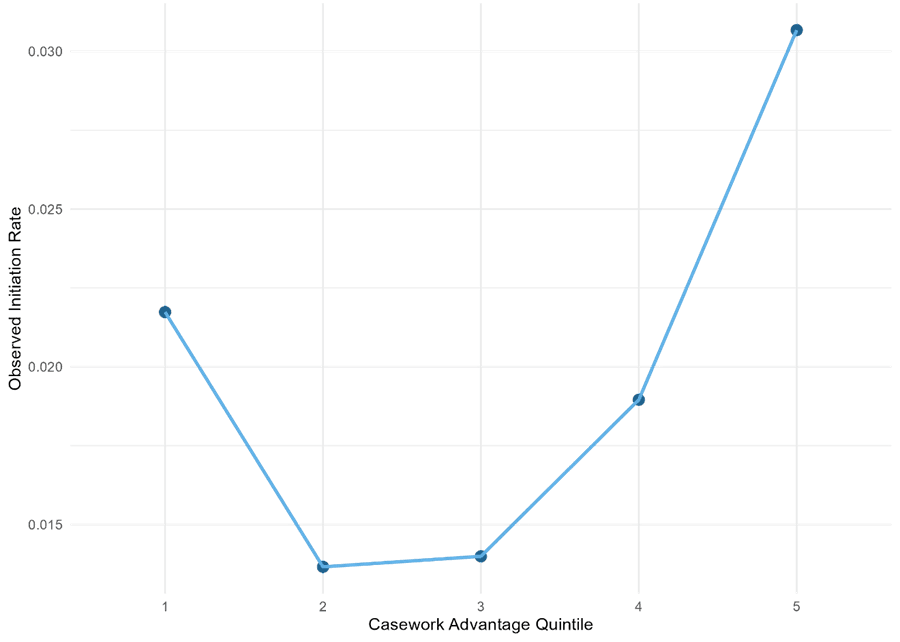
Note: All advantage indicators were drawn from New York City’s Community District Profile datasets for the year 2020, and normalized by relevant population or household denominators to ensure comparability across districts of varying size.
One might expect that those in the most disadvantaged districts would have the most contact with government programs, and, in turn, the most reason to request casework services. However, casework contact is instead strongly predicted by markers of civic advantage: education, income, citizenship, and English proficiency. This is what Blackwood calls the “first-mover bias.”
First-mover bias works like this: constituents who already have higher political knowledge, institutional familiarity, and trust in government are the ones most likely to contact their representative’s office. Those who lack those resources, who may have the greatest need but the fewest tools to navigate the system, are the least likely to ever appear on a caseworker’s desk. Importantly, these are both self-reinforcing experiences: someone who already has trust in their government and reaches out will likely deepen their trust in their government; someone who lacks resources to contact their representative, and thus loses benefits or struggles in navigating the system, will further lose trust in that same government.
Those who don’t initiate contact are, in a very real sense, invisible to representation.
A Design Problem, Not a Willingness Problem
It would be easy to read these findings as a failure of political will.
It isn’t.
Offices care. Staff work hard. The caseworkers Blackwood interviewed consistently described casework as meaningful and central to the office’s identity. The problem is structural; it was a default that made sense in a different era but now quietly reproduces the very inequalities in political participation that casework is designed to help correct.
When the model requires the constituent to initiate, the system inherits every inequality in civic knowledge, trust, and access that exists upstream. The more vulnerable someone is to administrative failure, the less likely they are to engage with the one service designed to help them navigate it.
What To Do With This
This research has practical implications for how government offices could approach constituent services.
Measure what you aren’t seeing: Case volume reflects who asks versus who needs help. By comparing service distribution against district demographics, you can identify gaps in service delivery and partner with outreach teams to overcome.
Lower the informational barriers to intake: Templates alone are not enough for some constituents. Offices that provide agency-specific guidance see meaningful improvements in uptake of the case.
Track “late arrivals:” Cases that show up in crisis are signals, both of unmet need and of where proactive outreach would pay off. Work with constituents to identify mechanisms for early intervention that can be applied in the future.
Applying even some of these practices has the potential to meaningfully improve how offices serve their constituents.
Civic’s Take
We know caseworkers are dedicated public servants. We see how hard they work. But even with that work ethic, they are slowly drowning under paperwork and administrative tasks. Their tech system doesn’t fit their day-to-day work to the extent that it could. So caseworkers supplement with spreadsheets and filing systems they build in their office, which disperses information that needs to stay connected.
When we built Revere, we knew we wanted to attend to this challenge. So we built a system in partnership with caseworkers to ensure it fits their needs. By providing a centralized system for managing casework, we hope that caseworkers will be able to support the constituents who reach out, as well as those that have not.
In the next blog post in this series, we’ll look at the alternatives to reactive casework.
This is the second in a four-part series drawing on Megan Rickman Blackwood’s 2026 dissertation, “Why Casework? Reimagining Political Representation Through Proactive Service” (UNC-Chapel Hill).



We build safe and powerful AI systems that transform government workflows, data management, and communications.