A Practical Guide to Proactive Casework

When a Virginia state legislative office stopped waiting for constituents to call and started calling them first, its validated casework requests jumped from 28 to 626 in three months. The share coming from marginalized constituents rose from 54% to 78%. That's the empirical core of Dr. Megan Rickman Blackwood's 2026 UNC-Chapel Hill dissertation, which formalizes the approach as Proactive Casework Theory.
A constituent receives a confusing notice from a government agency.
The notice is written in technical language. The deadline is easy to miss. The instructions assume the constituent already knows which agency to call, what documents to gather, and what will happen if they make a mistake.
At first, nothing looks like a crisis.
Then, the form is late. A benefit is paused. An application stalls. A payment disappears.
By the time the constituent calls their representative’s office, the caseworker is no longer helping with a simple administrative question. They are helping someone recover from a government failure that has already affected them personally.
The previous post in this series examined the consequences of The Reactive Trap. When casework depends on constituents initiating contact, the people most likely to receive help are either those who already have the knowledge, civic skills, and trust needed to ask, or those who have been pushed past a breaking point and have nowhere else to turn.
Everyone in between is easier to miss.
Because of this, improving casework may not just be about offering better service after a constituent reaches their representative, but also considering how representatives can reach constituents before a crisis does.
How do Congressional Offices Move from Requests to Reach?
In her dissertation, Dr. Megan Rickman Blackwood introduces Proactive Casework Theory as an alternative to the traditional reactive model of constituent service.
The core idea is simple: shift the burden to initiate the support from the constituent navigating a confusing system to the representative’s office that is already equipped to help.
Under the Reactive Casework Model, constituents face very real barriers to access. They must identify the problem, recognize that their representative may be able to help, find the correct contact information, trust that reaching out is worth it, and successfully navigate intake.
Under Proactive Casework Theory, the office makes the first move. Instead of waiting for constituents to know when and how to ask for help, legislative offices reach out directly, check on constituent well-being, and explicitly offer assistance with government programs and services.
This fundamentally changes the logic of access. Help is offered before a constituent has to decide whether asking is worth the risk. The question changes from “Should I reach out to the government?” to “Should I accept the help being offered?”
That difference matters. For many constituents, especially those who have had negative experiences with government, the hardest step is not filling out a form. It is believing anyone will help in the first place.
Can Proactive Casework Remain Personal?
There is an understandable concern here. The word “proactive” can sound technocratic, and you might imagine automated messages, or, offices trying to predict private problems before constituents have asked for help.
Proactive casework is not surveillance. It is not a replacement for caseworkers. And it is not about turning constituent service into a generic outreach machine.
At its best, proactive casework means using what offices already know from their own work to make help easier to find.
If an office knows that passport cases surge every Spring, it can begin outreach before travel season. If veterans are repeatedly struggling with the same VA documentation issue, the office can send clearer guidance before claims stall. If housing complaints tend to arrive only after months of failed agency contact, the office can partner with community organizations to meet constituents where they are and explain when and how their representative can intervene.
Caseworkers already do this informally. Experienced staff know which agencies are slow to respond, which forms are confusing, which deadlines create problems, and which constituents are least likely to call until a crisis has escalated.
The problem is that this knowledge often lives in individual memory, email threads, spreadsheets, and office lore. When it is not captured, the office has to relearn the same lessons again and again.
Proactive casework is one way to turn institutional memory into a functional strategy for service.
What Happens to Casework When Representatives Move First?
The promise of proactive casework is not only theoretical. As part of her dissertation, Blackwood piloted programs informed by Proactive Casework Theory in two state legislative offices — one in Virginia and one in Nevada — to observe what happens when offices move from waiting for requests to actively offering help.
The process was simple. By using voter contact lists available through organizations like L2, the representative and their volunteer teams met weekly to call constituents and ask a simple question: Are you having any issues with government services?
The Virginia pilot provides especially striking evidence. During a three-month reactive baseline period, the office recorded 28 validated casework requests. During a matched proactive outreach period, the same office generated 1,116 successful contacts and 626 validated requests—more than twenty times as many validated requests.
That kind of jump does not mean the government suddenly became twenty times more broken. Instead, it suggests the need was already there. The reactive model simply was not surfacing it.
The composition of cases changed too. Under the reactive model, 54% of validated requests represented marginalized constituents experiencing housing insecurity, Medicaid enrollment issues, food assistance delays, or disruptions in public benefits. Under the proactive model, that share rose to 78%.
Proactive outreach did not just increase the number of cases, it changed who became visible to the office.
The Nevada pilot began from a much lower-capacity setting. There was no existing phone bank, no case management platform, and casework had previously been logged by hand. While this restricted formal statistical comparison, the member estimated they had received roughly four casework requests in the year prior to the pilot. The pilot was smaller in scale than Virginia, as the available staff could only place calls part time during the 2-month legislative session. But, even in just those two months, they surfaced four casework requests–matching the amount estimated for the previous year in 1/6th of the time
The Nevada trial also produced one of the more telling moments in the project. A constituent who received a single proactive call was inspired enough to become a volunteer for the office helping to conduct the next round of outreach. That is more than a nice anecdote. It is a small example of how contact initiated by the representative has the power to catalyze further participation, rather than solely serve as a service transaction. Casework, done proactively, can double as civic learning.
Together, the two pilots make the same underlying point from different starting conditions: the reactive structure itself constrains access. Relax that constraint, and both the volume and the composition of need shift toward the people the reactive model was least likely to reach.
Casework Is Policy Feedback
Casework does more than resolve individual problems. It also tells offices where government is breaking down.
When constituents contact a representative about delayed benefits, denied applications, or unanswered calls, they are not only asking for help. They are reporting first-hand feedback on how policy is actually working in practice.
Under the reactive model, that feedback is incomplete. If only certain constituents are likely to initiate contact, offices receive a distorted map of need. High-resource communities may generate frequent requests about passports, grants, or business licensing, while lower-resource communities remain underrepresented in the caseload even when facing severe administrative burdens.
Silence does not mean absence of need. It may mean absence of access.
Proactive outreach has the potential to help offices correct that distortion. A representative who hears from a broader cross-section of their district has a more accurate picture of where programs are failing, where communication is breaking down, and where earlier intervention could prevent a crisis from forming in the first place. When leveraged correctly, proactive casework can inform both future policy and oversight activity.
How Can Caseworkers Act Proactively?
Should an office be interested in using a proactive approach to casework, it does not need to be all-or-nothing. Here are a few practical shifts to consider.
Recognize case volume is not a complete picture of need. Volume mostly measures who successfully asked for help. It does not tell an office who gave up, who never knew help existed, or who assumed the office would not respond.
Track late-arriving crises. A case that reaches the office only after months of failed agency contact is not just a hard case. It is a signal about where earlier outreach or clearer guidance might have helped.
Watch for recurring patterns. If the same agency, form, deadline, benefit, or neighborhood keeps showing up in your case audits, that pattern should shape outreach, not just intake. Share these insights with your legislative team.
Preserve institutional memory. When staff leave, the office should not lose what that staffer knew. The next caseworker should be able to build on the last one’s experience.
Design around the least familiar constituent. The measure of a good casework system is not whether an experienced constituent can use it. It is whether someone overwhelmed, distrustful, or unfamiliar with the government can still find their way to help.
Reactive casework will always matter. Constituents will always need a place to turn when the government fails them, and offices will always need skilled caseworkers who can listen, escalate, and follow through. But reactive casework does not have to be the whole model. Offices could consider going beyond asking who reached out, and toward asking who did not, and why.
There may be several benefits to a proactive approach. It has been shown to surface more cases, especially among constituents who otherwise are often not engaged in this way. It also builds efficiencies within the office, by preserving institutional memory and promoting shared learning among staff. Ultimately, proactive strategies may also bolster trust in government by intervening before constituents give up.
How Can Revere Help Caseworkers Act Proactively?
At Civic, we understand the stakes of casework. And, too many offices are asked to do this work with tools that were not built around how casework actually happens.
Caseworkers deserve a platform that preserves institutional memory, surfaces patterns across cases, and helps staff act earlier without adding more manual work to an already overwhelming job.That is the infrastructure Civic is building with Revere.
Within our caseworker dashboard, staff can quickly tag incoming cases by agency, program, and issue type, then aggregate those tags to see patterns that used to live only in a caseworker's memory.

Case tagging in Revere's dashboard, the foundation for the pattern view in the map below. Screenshot taken from platform 7/16/2026.
Revere's constituent contact heat map then turns that same tagging into a geographic view, showing where requests are originating across the district.
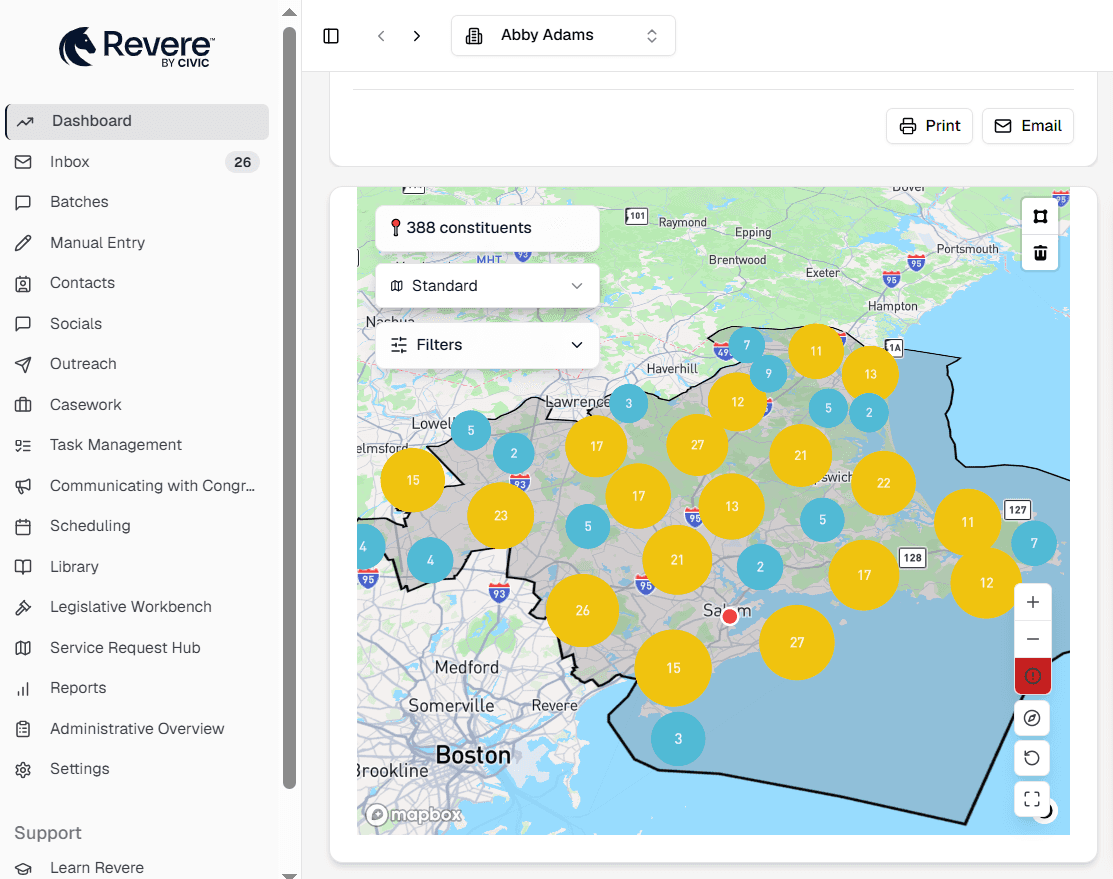
Revere's constituent contact heat map shows where cases are originating across a district, making it easy to spot clusters by zip code or neighborhood. Screenshot taken from platform, 7/16/2026
An office can see at a glance whether a cluster of cases is coming from a specific zip code, township, or neighborhood, the kind of pattern that's easy to miss case-by-case but obvious once it's mapped. That visibility is what makes proactive outreach targeted rather than generic. An office doesn't need to guess who to call first; the map shows them.
And because every case is tagged consistently, staff can quickly see which agencies and programs are generating the most casework at any given time. That insight doesn't just help staff manage today's caseload. It tells the office where to focus tomorrow's outreach, and it gives them the evidence base to raise systemic issues with the agencies themselves.
Civic isn’t building technology that replaces caseworkers, but technology that helps them see more clearly, act sooner, and reach more constituents before they reach out in a crisis.
———
This is the third in a four-part series drawing on Megan Rickman Blackwood’s 2026 dissertation, “Why Casework? Reimagining Political Representation Through Proactive Service” at UNC-Chapel Hill.



We build safe and powerful AI systems that transform government workflows, data management, and communications.