The Infrastructure of Attentive Government

The previous posts in this series have argued that casework is one of the most direct ways Americans experience political representation, that the traditional reactive model rewards constituents who already know how to ask for help, and that proactive casework can help offices reach more people.
Proactive Casework Theory is not simply a different attitude toward constituent service. It suggests casework could work differently. But, choosing to pursue a proactive approach is different from having the organizational capacity to accomplish it.
An office cannot act on patterns it cannot see. It cannot preserve knowledge scattered across inboxes, spreadsheets, and individual memory. And, importantly, it cannot reliably follow through when stalled cases remain invisible within a growing workload.
That is why the final step toward proactive casework is not simply changing what offices intend to do. It is building infrastructure that can actually help them achieve it.
How Can Casework Systems Help Strengthen Constituent Service?
It is easy to think of casework systems as back-office tools: places to store requests, track correspondence, upload documents, and close cases. But for an office to deliver on their casework goals, the casework infrastructure also should help offices do three things well: notice, follow through, and remember.
First, systems should help offices notice need. That begins with making it easier for constituents to reach the right person and ensuring that requests do not remain buried in a general inbox. But it also means helping offices see beyond the individual messages in front of them. Which agencies are generating the most requests? Which programs repeatedly create confusion? Are problems concentrated in a particular neighborhood or among constituents facing similar circumstances?
Second, systems should help offices follow through. Many constituent problems take weeks, months, or, like some complicated immigration cases, years to resolve. They require repeated agency contact, additional documentation, escalation, explanation, and reassurance. In a busy office, even a committed caseworker can lose sight of a stalled request amid dozens of new ones. Infrastructure can help staff identify which cases are waiting, which deadlines are approaching, and which constituents may be at risk of falling through the cracks.
Finally, systems should help offices remember. Caseworkers accumulate enormous practical knowledge about agencies, deadlines, recurring errors, effective escalation strategies, and the circumstances that make some cases especially urgent. But too often, that knowledge remains fragmented across emails, spreadsheets, case notes, and individual staff members. When someone leaves the office, years of experience can leave with them.
But these capacities are not merely operational. Each one shapes the constituent’s experience of government
When information is difficult to find, staff have less time to listen. When cases can quietly stall without appearing on a manager’s radar, constituents experience the consequences. When records are disconnected, offices repeatedly reconstruct knowledge they already possess.
GovTech developers have a responsibility to consider these consequences deliberately. The question cannot be limited to whether a system stores information or moves a case through a workflow. It should also be whether that system helps an office notice what it might otherwise miss—and pay attention when it matters most.
Civic’s Take: Revere’s Casework System
At Civic, we believe that casework deserves better tools: intake that’s easier for constituents, records that stay connected instead of siloed, institutional memory that survives staff turnover, and the ability to spot recurring problems across agencies without asking an already-overloaded caseworker to build another spreadsheet by hand.
That’s why we built Revere’s casework module around the idea that casework goes beyond an operational function. It is democratic infrastructure. Not technology for its own sake, but a way to help offices see more clearly, respond more consistently, and reach the constituents who need it.
Because a government official’s inbox isn’t just an inbox, it is the front door to government assistance.
As we designed Revere, this meant it was important to isolate opportunities to increase accessibility like our automated message triage which routes incoming contacts directly to caseworkers instead of leaving them to linger in general office inboxes. Simplifying intake to help constituents reach the right staffer when casework is time sensitive wasn’t just about streamlining workflow, it was about supporting government responsiveness.
As we learned from the Congressional staff that served as our design partners, a response-time tracker is not just a management feature that is “nice to have”; instead, it determines how quickly a constituent learns that someone is paying attention. Implementing an automatic “At-Risk” flagging system for cases that fall outside of normal processing time, and surfacing this information immediately on casework managers’ custom dashboards within Revere, didn’t just reduce supervisory burden. It also functions as a safety net, catching constituents who may have fallen through the cracks.
We also understand that a searchable case history is not just about convenience, but rather it is how one constituent benefits from what the office learned while helping another. That’s why rather than relying on a general-purpose model trained on public internet data to power a chatbot for caseworkers, Revere’s AskPaul uses retrieval-augmented generation to ground responses in the district’s own constituent records, casework history, and office-specific documentation. That means the knowledge an office develops through years of casework does not have to remain locked inside individual case notes, or, disappear when an experienced staffer leaves.
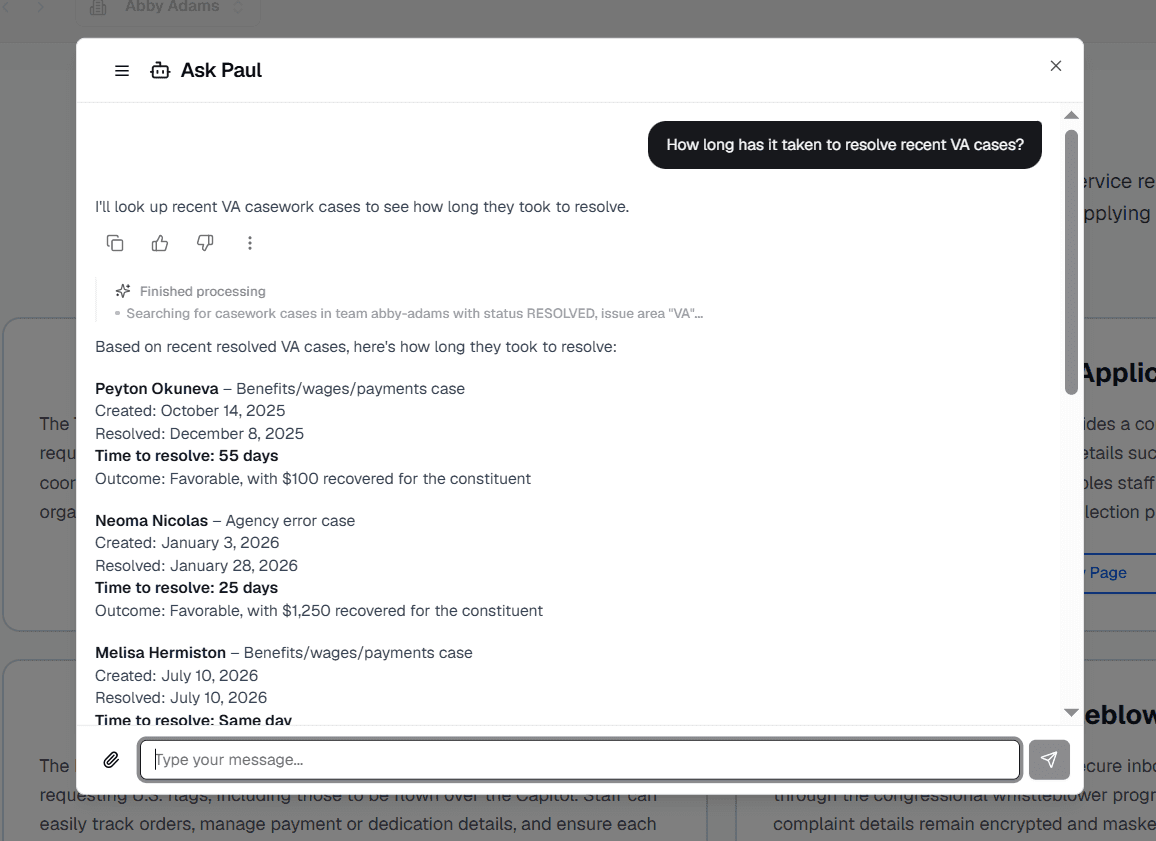
As policies change and new information comes in, staff can draw from the office’s current records and trace answers back to their underlying sources. The goal is not to replace caseworker judgment with an AI-generated answer. It is to make the knowledge caseworkers have already built easier to find and use. AskPaul draws on the latest verified records rather than a static, potentially outdated model.
For staff, this translates to faster, more accurate triage and pattern recognition on live cases, with responses traceable back to source documents rather than generated from an opaque black box. This is a critical distinction when offices need to justify how a constituent’s information was handled.
Protecting the Human Work of Casework
Talking about infrastructure this way creates a real risk. It can make the future of casework sound like automation, prediction, and mass outreach.
It is not.
Casework depends on human judgment: listening closely, reading context, and knowing when a constituent is confused, frightened, or simply worn down by a process that should have been easier. It requires deciding when a routine delay has become an urgent problem, when an agency’s technically accurate response does not actually resolve the issue, and when a person needs reassurance as much as they need information.
No system can perform that relationship on a caseworker’s behalf. At most, technology can protect the time and attention those relationships require.
It can surface relevant history instead of making staff hunt for it. It can catch duplicative data entry, flag follow-ups that have not closed, and show when a new case resembles one the office has already solved.
Better infrastructure does not make casework less human. It gives caseworkers more room to do the parts of the job that are distinctly human: listen, interpret, reassure, escalate, and follow through.
That principle has shaped how we have approached the design of Revere.
Closing our Casework Series
The central theme running through this series has been whether casework is peripheral to representation or one of the places political representation becomes most real. If it’s the latter, then it can’t be treated as a secondary administrative task, run on tools built only to receive, store, and close requests, dependent on memory that disappears when staff leave, or measured only by how many constituents already knew how to find the office.
An office that seeks to be most responsive to such cases requires more from their systems than that. It requires records that hold onto context, workflows that help staff follow through, pattern recognition that turns individual cases into institutional learning, and outreach that can reach those who have been silent. Underneath all of it is something every experienced caseworker already knows – that government often becomes real to people in the moment someone actually listens, responds, and helps them find a way through.
If casework is one of the places representation becomes real, then building institutions capable of doing it well is not simply an administrative challenge. It is part of the work of representation itself.
———
This is the fourth in a four-part series drawing on Megan Rickman Blackwood’s 2026 dissertation, “Why Casework? Reimagining Political Representation Through Proactive Service” at UNC-Chapel Hill.



We build safe and powerful AI systems that transform government workflows, data management, and communications.